2025 was a rough year for frontline communities advocating for Environmental Justice (EJ). Federal EJ funding was slashed, and local governments centering EJ principles were strained due to political uncertainty. Consequently, community-based organizations (CBOs) advocating for community-informed decision-making faced governmental staff with limited capacity and funding.
Despite this landscape, equitable decarbonization was still front and center throughout the year. In 2025, IMT braided federal and philanthropic funding to connect nine governments with community-based organizations to co-create building decarbonization policies. In St. Louis, that support helped create something more durable than a one-time engagement process: it helped build a collaboration lane between community-based organizations, technical partners, and city implementers.
St. Louis had momentum, but not a complete table
St. Louis has a history of diverse partners who are deeply invested in the health and habitability of their building stock. This network of partners has a track record of collaborating across sectors to center affordable and healthy buildings in projects such as the Affordable Housing Report and Economic Justice Action Plan.
When the city passed Benchmarking in 2017 and a building energy performance standard (BEPS) in 2020, a web of building owners and local organizations all wanted to know what these policies meant for them. Partners ranging from affordable housing providers and community development corporations to environmental consultants and workforce associations began to understand the effects of policy implementation and anticipate updated policies on the horizon. These folks were not alone; they had supports such as the Building Energy Exchange (BE-Ex) St. Louis and the Missouri Gateway Green Building Council, to share resources, break down the science, and help building owners comply with regulations.
However, some voices were missing from the conversation. IMT, who has been involved in St. Louis for over a decade, recognized a need to reach out to longtime community-based organizations as a way to understand potential unintended consequences of these policies. We deployed a new community engagement process in early 2024 to invite new and missing voices to the table.
From ecosystem mapping to local partnership
Our community engagement process aims to provide a person-centered approach for communities to participate in policy while increasing justice in their communities.
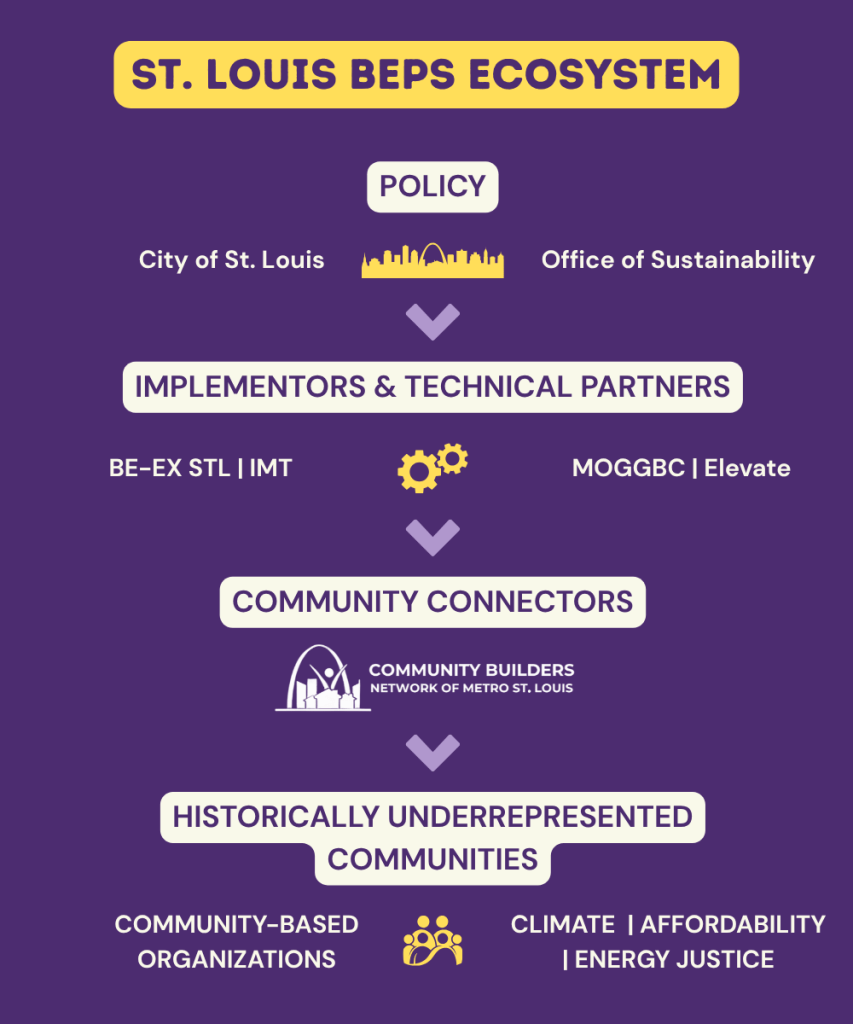
In St. Louis, we started this process by ecosystem mapping to identify decision makers, implementors, and intermediaries who have the power to influence BEPS implementation, and historically underrepresented communities who feel the effects of BEPS implementation. In particular, we focused on CBOs spanning across climate, affordable housing, and energy justice to address multiple sectors BEPS may impact. After methodical mapping, we identified Community Builders Network (CBN) as a leader with trust and connection to partners not currently engaged in BEPS implementation. Through the Community Climate Shift Network, CBN received funding to share their expertise as a convenor and explore building decarbonization priorities across their membership.
Creating a collaboration lane: The CBN and MOGGBC partnership
CBN is a local community-based organization that has convened dozens of organizations over 30 years to address historic disinvestment in marginalized neighborhoods. For their members, CBN provides capacity-building workshops, builds bridges for policy involvement, and participates in three different coalition spaces. Convening community around building concerns is nothing new for CBN. They have been a prominent player in the St. Louis Vacancy Collaborative, Community Development Financial Institution Coalition, and Affordable Housing Trust Fund Coalition for years. Building energy, on the other hand, was a new endeavor. To tease out what BEPS meant to their members, CBN leveraged their membership and partnered with the Missouri Gateway Green Building Council (MOGGBC) to co-engage and co-convene their network.
Together, CBN and MOGGBC, with the input from technical partners (BE-EX STL, IMT, and Elevate), developed an engagement process to gauge concerns with current BEPS implementation—something of interest to implementers of BEPS—and assess the landscape of affordable housing—a high priority to CBN’s membership.
With these priorities in mind, CBN and MOGGBC circulated a Building Decarbonization Knowledge Assessment survey to gauge current knowledge about building decarbonization and identify barriers to implementation. The assessment solidified challenges already known: participants have limited awareness of decarb opportunities and have limited opportunity to collaborate with other organizations or local governments to implement decarb opportunities.
Anticipating these challenges, CBN, MOGGBC, and technical partners (IMT, BE-EX STL, and Elevate) invited and compensated a subset of respondents to workshop decarb challenges, education, and collaboration opportunities over the course of nine months. The collaborative space was named the Healthy Buildings Visioning Group (HBVG) to center the group on people-centered language and outcomes.
Does your organization provide any education or materials on energy efficiency or building improvements?
Building Decarbonization Knowledge Assessment survey by CBN and MOGGBC
Developing Dialogue: St. Louis Healthy Buildings Visioning Group (HBVG)
The HBVG aimed to deepen dialogue across different types of partners all interested in healthy and affordable buildings. The group’s formal scope was to gutcheck technical analyses happening simultaneously for accuracy, inform educational materials, and respond in real-time to emerging community needs.
The group kicked off by discussing the needs for building decarbonization implementation and analysing the learnings from the survey, but quickly pivoted in the wake of the severe EF3 tornado that hit the city on May 16, 2025. The tornado exacerbated inequities already present in the built environment and prompted the HBVG to lean into the intersections of policy and climate resilience through the lens of natural disaster response.
With this in mind, Rajiv Ravulapati, IMT’s Director of Government & Utility Engagement, developed a system mapping framework to explore how existing building data can inform the full system of buildings, people, neighborhoods, policy, and equity in St. Louis. By facilitating the HBVG through a series of systems mapping exercises, CBN, MOGGBC, and IMT led the group to think more broadly about the lanes they occupy and the ability of building data to tell the experiences of their communities.
Data wasn’t the only theme that emerged from the systems mapping exercises. Education and resource accessibility were identified as high priorities to bridge connections between building data, people, and policy. As a result, MOGGBC and BE-EX leaned on the HBVG to inform materials already in development, including their Affordable Housing Decarbonization Playbook, Affordable Housing Decarbonization Implementation Guide, and Affordable Housing Decarbonization Glossary.
What Lasted
The HBVG disbanded in November 2025, but the lessons learned are still reverberating. Resource accessibility and education are key themes for the City of Saint Louis and BE-EX going into the next BEPS compliance cycle. The collaboration lane created by CBN and MOGGBC is still present, and allowed for an end of year strategy session between CBN, MOGGBC, the city’s Office of Sustainability, BE-EX, and IMT. More broadly, the affordable housing and education challenges identified through CBN’s and MOGGBC’s engagement process informed IMT’s community engagement strategies into 2026.
The lasting value of this work was not just the dialogue that happened during the HBVG process, it was the coordination infrastructure that emerged from it: stronger relationships, a clearer shared language, and an opportunity for further collaboration for equitable building decarbonization in St. Louis. Special thanks to Linda Nguyen (Executive Director) and Aja Corrigan (Operations Coordinator) with CBN, Emily Andrews (Executive Director) with MOGGBC, and Malachi Rein (Director) with BE-EX STL.